
The Hidden Cost of High Achievement: Why the Most Successful People Are the Most Underserved in Mental Health
September 23, 2026
There is a particular kind of exhaustion that nobody talks about at the top.
Not the exhaustion of failure. Not the exhaustion of struggle. The exhaustion of success — of carrying extraordinary external achievement on an internal system that was never built to sustain it. Of performing brilliantly in every room while quietly running on empty in all of them.
This is the experience that sits at the centre of my clinical work. And it is the experience that the mental health system — by design, by default, by decades of reactive thinking — has almost entirely failed to address.
The System Was Built for Crisis. High Performers Never Look Like They Are in One.
Psychology and psychiatry have historically operated as emergency services. The architecture of mental health care — from GP referrals to waitlists to clinical thresholds — was designed to catch people when they fall. To intervene after the breakdown, the crisis, the point at which functioning becomes impossible.
This is a reasonable design for the people it was built for. It is a catastrophic design for high performers.
Because high performers do not look like they are in crisis. Their anxiety does not stop them functioning — it makes them function harder. Their perfectionism does not look like pathology — it looks like excellence. Their nervous system is running at double capacity, and the clinical system looks at them and says: you are fine. You do not qualify.
The data tells a different story.
26% of executives report symptoms consistent with clinical depression — compared to 18% in the general workforce. Nearly half of all CEOs report feelings of loneliness and isolation. 72% of entrepreneurs report experiencing mental health challenges — with anxiety, burnout, and depression running simultaneously and invisibly. In Canada specifically, 1 in 10 people waited 143 days — nearly five months — just for their first mental health counselling appointment.
These are not numbers from a broken system in a developing country. These are the numbers inside a universal healthcare system in 2026. In a world that has never talked more about mental health — millions of people who need support are not getting it. And the group least likely to get it, least likely to seek it, and most likely to need it before things go wrong is the one we celebrate the most: the high achievers.
Why High Performers Are the Most Vulnerable — and the Least Likely to Reach Out
There are three reasons high performers consistently fall through the gaps of the mental health system. Understanding them is the first step to addressing them.
The first is visibility.
The mental health system was designed around visible distress. High performers are experts at making invisible distress look like composure. The executive who delivers a flawless board presentation while managing clinical anxiety. The athlete who breaks a personal record while their nervous system is running a sustained threat response. The founder who closes a funding round while quietly unable to switch off at 2am.
From the outside: performing. From the inside: barely holding the system together.
The system cannot see what it was not designed to look for. And it was not designed to look for this.
The second is stigma — a specific kind of stigma that nobody names.
The stigma that high performers carry around mental health is not the same stigma that public health campaigns address. It is not the fear of being seen as "crazy" or "weak" in a general sense. It is the fear of being seen as not good enough for the position they hold, the authority they carry, the confidence of the people who depend on them.
Vulnerability at the top has a cost. Leaders cannot easily show uncertainty without undermining authority. Athletes cannot easily admit psychological struggle without risking their starting position. Founders cannot easily acknowledge burnout without affecting investor confidence or team morale.
And so they carry it. Quietly, competently, indefinitely — until they cannot.
The third is identity.
This is the one that clinical psychology has not discussed loudly enough. For many high performers, the performance is not just something they do. It is who they are. The athlete is not just an athlete — they are sport. The founder is not just building a company — they are the company. The executive whose self-worth is entirely woven into their results, their title, their position.
When this is the case — when identity and performance become fused at the neural level — a bad quarter is not a bad quarter. It is evidence of inadequacy. An injury is not a career disruption. It is a psychological crisis. A failed launch is not a business setback. It is proof of something deeper and more frightening.
Research on identity fusion in athletes is unambiguous: those who tie self-worth to performance outcomes are significantly more likely to burn out, underperform under pressure, and experience significant psychological distress at career transitions. The same pattern runs through founders and executives in every study that has looked for it.
What High Performers Actually Need — and What the System Does Not Provide
Traditional mental health care operates at the level of crisis intervention or symptom management. You present with symptoms severe enough to meet clinical thresholds, you receive a diagnosis, you begin treatment — typically cognitive behavioural therapy, medication, or both — aimed at reducing those symptoms to a manageable level.
This model has genuine value. For the populations it was designed for, it works.
But it was not designed for the high performer who is not yet in crisis. Who is not yet meeting clinical thresholds. Who is carrying something significant, quietly, while continuing to function at an extraordinary level externally. And who will, without the right support, continue carrying it until the system finally becomes visible — at which point the damage is far deeper and the recovery far longer than it ever needed to be.
What this population actually needs is not crisis intervention. It is performance infrastructure.
The distinction matters enormously. Performance infrastructure is not about treating pathology. It is about building the internal systems — the neural regulation, the identity stability, the pattern awareness, the recovery capacity — that determine how high a person can go and how long they can sustain it. It is the psychological equivalent of what elite sports programmes have known for decades: you do not wait until an athlete is injured to address their physical conditioning. You build the system that prevents the injury in the first place.
This is preventive psychology. It is the branch of the field designed from the ground up for this population — not crisis intervention, not symptom management, but proactive optimisation of the system running the performance.
And it is almost entirely inaccessible in the mainstream mental health model.
The Three Patterns I See Most in High-Performing Clients
In my clinical work with athletes, founders, executives, and high performers across multiple domains, three patterns appear with remarkable consistency. They are rarely named by the people carrying them — because from the outside, they look like strengths.
Pattern one: the productivity that never stops.
The person who cannot tolerate stillness. For whom rest feels like falling behind, and falling behind feels like losing a core part of who they are. For whom the stopping is more terrifying than the continuing, even when the continuing is clearly unsustainable.
This does not look like a problem from the outside. It looks like an extraordinary work ethic. Internally, it is a nervous system that learned — somewhere, at some point — that productivity was the only safe way to be. That being enough was contingent on doing enough. That the moment you stopped, something terrible would be revealed about who you actually are.
Pattern two: the hyper-independence.
The person who does everything alone. Who asks for nothing, delegates reluctantly, and treats the need for support as a personal failure rather than a human reality. Who has learned — often through early experiences where depending on others led to disappointment or abandonment — that the only truly reliable person is themselves.
From the outside: extraordinarily capable. A natural leader. The person who always figures it out.
Internally: profoundly isolated. And often at the centre of a pattern that systematically prevents the kind of authentic connection that would actually sustain them through the demands of high performance.
Pattern three: the standards that move.
The person for whom achievement is never quite enough. Who reaches the goal, experiences a brief period of satisfaction, and immediately moves the bar. Who cannot receive positive feedback without immediately identifying the gap between the result and the ideal. Who works tirelessly toward an excellence that is, by design, permanently out of reach.
From the outside: driven. Ambitious. Relentless.
Internally: a cycle of achievement and inadequacy that drives performance while quietly eroding the person doing the performing.
These are not character flaws. They are learned neural patterns — adaptive responses that once served a genuine purpose, are now the ceiling, and are almost never addressed in a system that only intervenes after they produce visible breakdown.
Why We Built Neuropsych and Counselling the Way We Built It
Neuropsych and Counselling was built around one foundational belief: that the most important performance work a high achiever can do is the internal work — and that work should be accessible before crisis, not after it.
We operate virtually-first across Alberta. No referral required. No waitlist. No clinical threshold to meet before you deserve support. We work with athletes, founders, executives, and high performers who are already performing at an extraordinary level — and who know, or sense, that there is another level they have not been able to access yet.
Not because they lack talent. Not because they lack effort. But because the internal architecture — the neural patterns, the nervous system regulation, the identity stability under pressure — has never been properly built and trained.
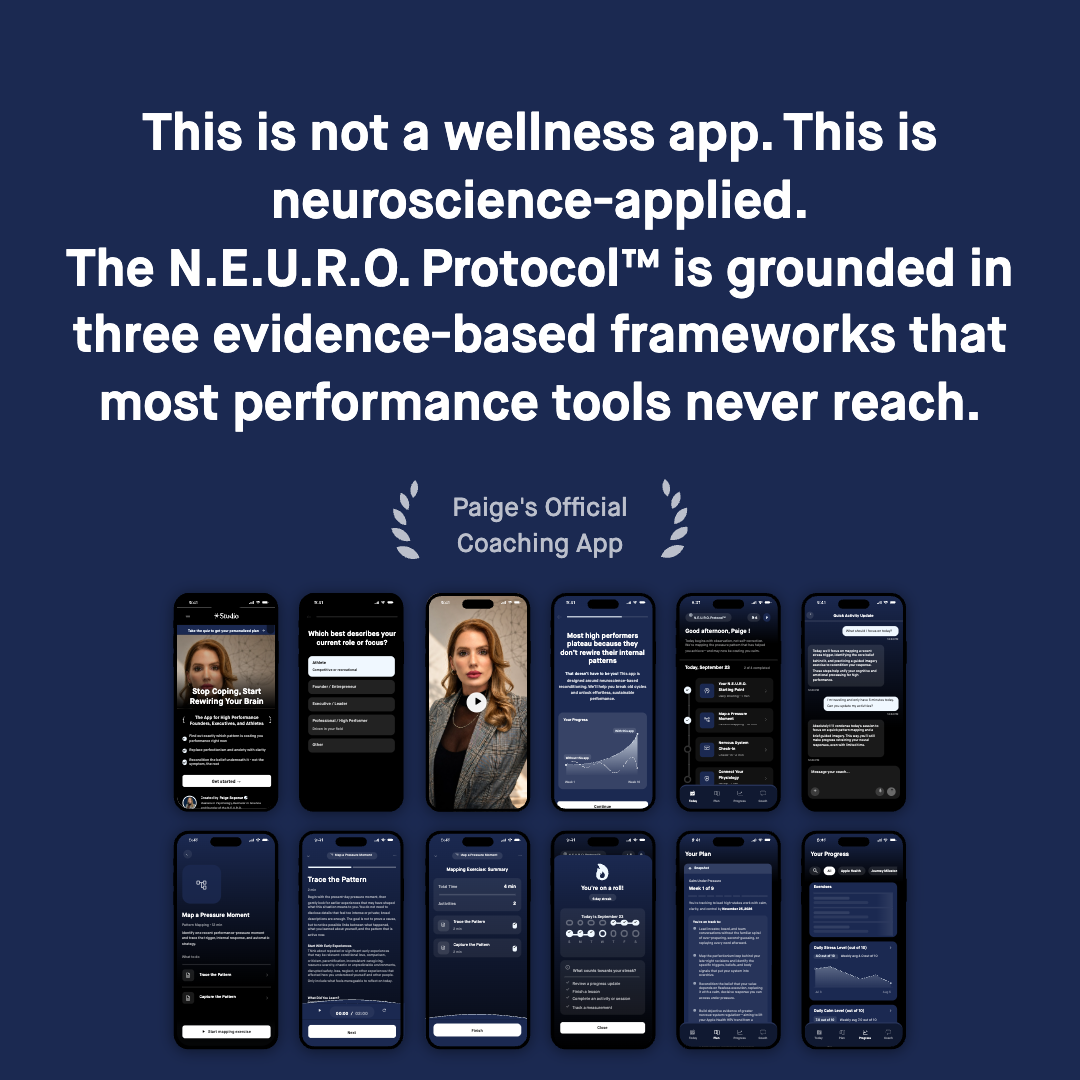
The N.E.U.R.O. Protocol™ — our proprietary neuroscience-based framework integrating schema therapy, cognitive reprocessing, and guided prospective imagery — is designed to do exactly this. Not to manage patterns but to map them, clear them at the root, and rewire the neural response permanently.
This week, the N.E.U.R.O. Protocol™ becomes an app.
Because the gap between who needs this work and who can access it is too wide — and we are determined to close it.
You Do Not Have to Be in Crisis to Deserve This Work
The most important thing I want every high performer reading this to understand is simple.
You do not have to be broken to deserve support. You do not have to be in crisis to justify investing in your internal architecture. You do not have to reach the point of collapse before the work becomes worthwhile.
The best time to build psychological infrastructure is before you need it. The best time to address the patterns is before they compound. The best time to invest in the system running everything else is right now — while you are still performing, still building, still in the game.
Because the ceiling you keep hitting is not talent. It is not strategy. It is not effort.
It is the system underneath all of it — running the same patterns it has always run, doing what it was taught to do, waiting for someone to finally show it a different way.
That is the work. And it is the most important performance investment a high achiever can make.
We are launching with 50% off for the first 100 people who sign up. Half price. First come, first served. Email us info@theperformancecode.org